Colmar → Alsace → France
Colmar: a practical guide for first-time visitors
Colmar is the largest town in central Alsace and the base most first-time visitors end up choosing. This guide covers what it offers, how long it holds your attention and when a village would suit you better.
- Published
- Last reviewed
Why visit Colmar
Colmar sits in the Alsace plain, a few kilometres east of the vineyard slopes and the Alsace Wine Route. It is a town of around 70,000 people with a well-preserved historic core, a railway station on the Strasbourg–Basel line and enough restaurants, shops and museums to fill several days without a car.
Two things distinguish it from the wine villages. First, function: a station, car hire, pharmacies open on Sunday, later dinner service, a choice of accommodation at different prices. Second, art and history at a level a village cannot offer — the Unterlinden museum holds the Isenheim Altarpiece, and Colmar is the birthplace of Auguste Bartholdi, who designed the Statue of Liberty.
How many days to spend
- One day — the Old Town, one museum and a meal. Enough to see Colmar, not enough to use it.
- Two days — the Old Town at a slower pace, two museums, and one half-day trip into the vineyards.
- Three to five days as a base — where Colmar makes most sense: day trips to the Wine Route villages, one day in Strasbourg, and evenings back in a town that stays open.
The Old Town
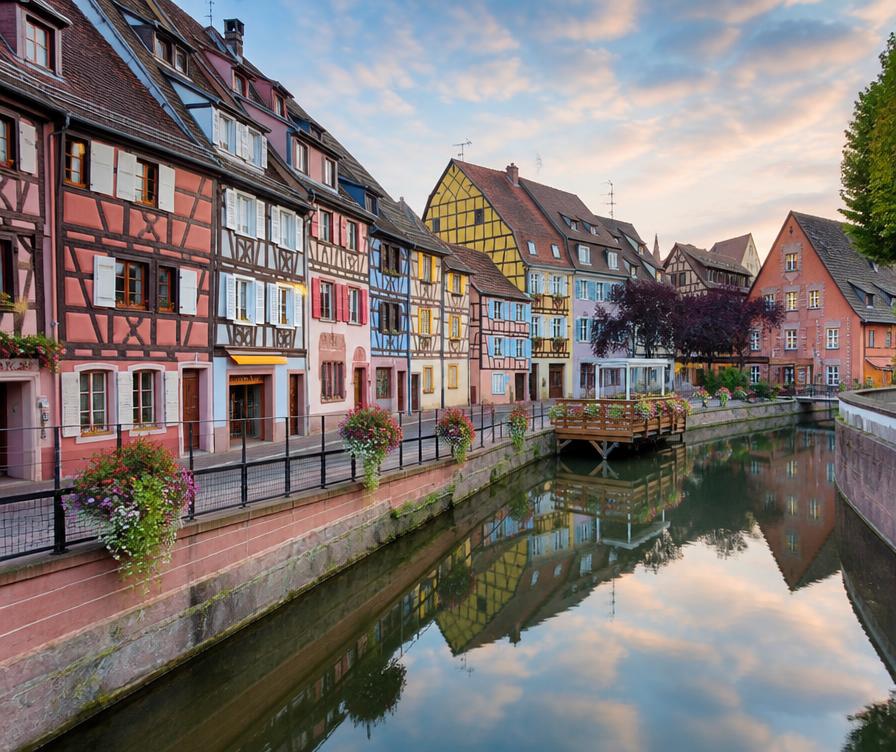
The historic centre is compact and walkable. Its best-known corner is Petite Venise, where houses line the Lauch river; the Tanners' Quarter nearby has tall timber-framed buildings once used for drying hides. The covered market hall is a working food market rather than a souvenir arcade, and a good first stop for cheese, charcuterie and pastries. Around the collegiate church and Place de l'Ancienne Douane you will find the large merchant houses that reflect Colmar's trading past.
The central streets are busiest between mid-morning and late afternoon. Early and late in the day the same streets are close to empty.
Food and wine
Colmar has the widest range of eating options in the area: winstubs serving regional dishes, formal restaurants, bakeries, and cafés that stay open later than village ones. Alsatian standards — tarte flambée, choucroute garnie, baeckeoffe, kougelhopf — appear on most menus, alongside wine lists dominated by Alsatian bottles sold by grape variety.
Wine shops and tasting rooms in town let you compare producers you cannot easily reach in a day. It is a good place to work out what you like before visiting estates on the route. We do not publish named restaurant recommendations until we have eaten there and can date the visit.
Colmar as a base for the Wine Route
This is Colmar's strongest argument. The central section of the Wine Route — Kaysersberg, Riquewihr, Ribeauvillé, Eguisheim — lies within a 10 to 30 minute drive, and organised half-day tours leave from the town. Regional buses reach several villages, and cycle routes run out through the vineyards. You can spend your days among vines and your evenings in a town where dinner does not end at half past eight.
The trade-off is that you are not in the vineyards. You will not see the villages at dawn, and you will spend part of each day travelling. Where to stay in Alsace sets out both sides.
With or without a car
Colmar works well without a car: the station has direct regional services, the Old Town is walkable, and tours and buses cover the Wine Route. A car adds reach — small villages, estates between them, the Vosges — but the historic centre has restricted traffic and paid parking, so many visitors park on the edge or use a hotel with parking. If you are driving only for day trips, hiring a car for one or two days is worth considering.
Day trips from Colmar
- Wine Route villages: Eguisheim and Kaysersberg are closest; Riquewihr and Ribeauvillé slightly further north.
- Strasbourg, reachable by direct regional train, for a full day in a much larger city.
- The Vosges foothills, for forest walks and views back over the plain.
- Vineyard walks that start from villages a short drive away and need no special equipment.
Christmas in Colmar
Colmar runs several Christmas markets across different squares during Advent, and the town becomes very busy — particularly at weekends, when accommodation and restaurants fill and traffic slows. Weekdays are noticeably calmer. As a base at this time of year Colmar has a practical advantage: you can reach village markets by day and return to a town with a wide choice of places to eat.
Market dates, opening times and market locations change from year to year, so we publish them only once verified.
Where to stay in Colmar
Staying inside or on the edge of the Old Town means you can walk everywhere, at the cost of parking convenience and some evening noise. Properties near the station suit car-free visitors and early trains. Outside the centre, hotels with parking make sense if the Wine Route is your main focus. Advent and summer weekends should be booked well ahead.
We do not list individual hotels; when we do, entries will carry a verified date.
Practical advice
- Visit the Old Town early or in the evening to avoid the mid-day peak.
- Check museum closing days before planning a rainy afternoon around one.
- Buy Wine Route tour tickets ahead in high season and Advent.
- Confirm whether your accommodation includes parking before driving in.
- Book restaurants in December and on summer weekends.