Alsace, France
The Alsace Wine Route
A first-visit guide to the route that runs along the eastern foothills of the Vosges in Alsace, France — what it actually is, which villages to choose, how wine tasting works and how long to allow.
- Published
- Last reviewed
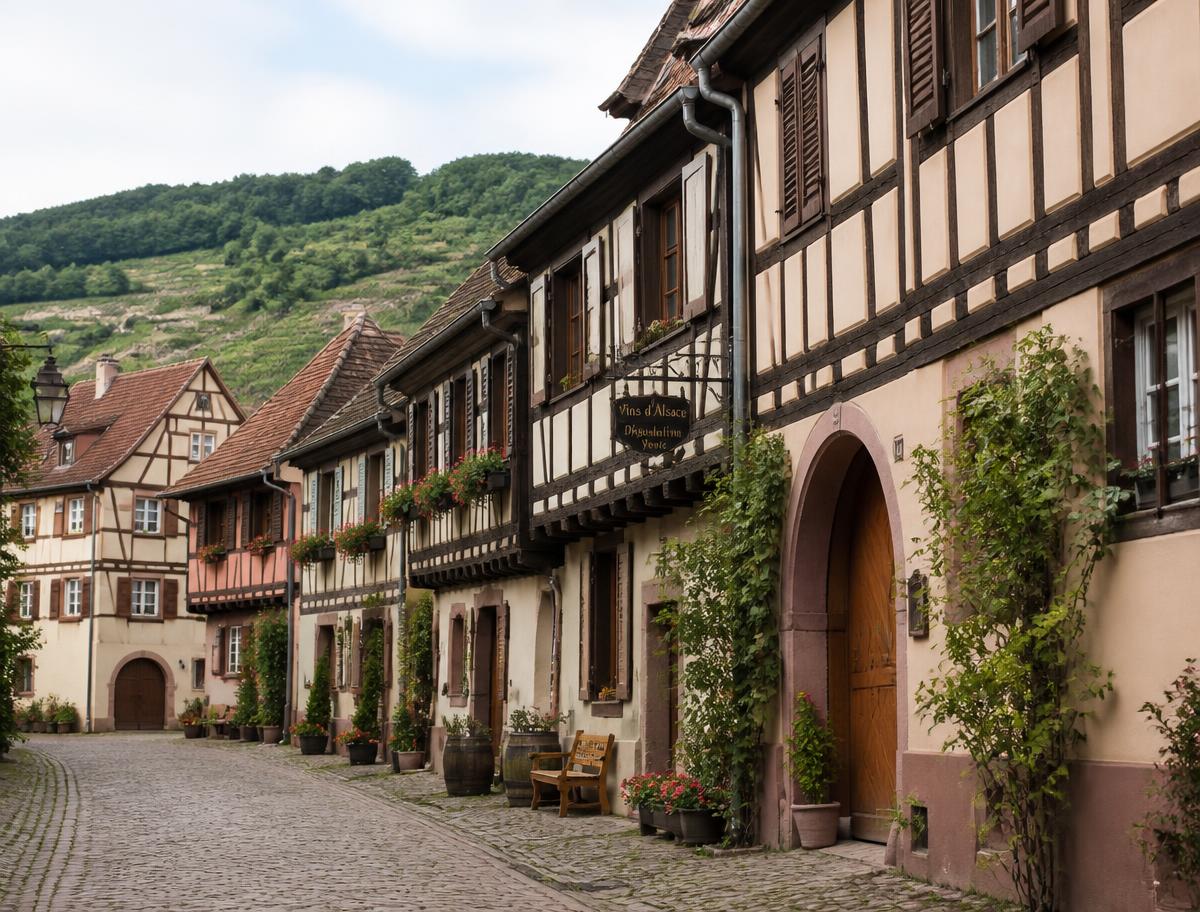
What the Alsace Wine Route is
The Alsace Wine Route (Route des Vins d'Alsace) is a signposted touring route through the wine-growing area of Alsace, in eastern France. It is not a single road but a linked series of country roads that run roughly north to south along the eastern slopes of the Vosges Mountains, passing through the villages whose economies have been built on wine for centuries. Alsace sits between the Vosges and the Rhine, with Germany on the far bank; the region belongs to France, and its architecture, dialect and cooking carry the traces of a long shared border.
Practically, the route is a way of organising a trip. Rather than one destination, you move between villages a short distance apart, stopping for tastings, walks, meals and views over the vineyards. Most itineraries concentrate on the central section between Colmar and Ribeauvillé, because the villages there are closest together.
Why international travelers consider it
Three things tend to make the difference for visitors from abroad. The scale is manageable: villages are minutes apart, so a day can include several without long drives. The wine is made largely by family estates that receive visitors themselves, which makes tasting feel less formal than in some better-known French regions. And the landscape is unusually legible — you can see the vineyard slopes, the villages set at their foot and the forested Vosges ridge behind them from a single viewpoint.
The geography, briefly
Vineyards occupy the sunny lower slopes between the mountains and the Rhine plain. Two towns anchor the region: Strasbourg in the north and Colmar in the centre-south. The northern part of the route, around Obernai, is close to Strasbourg; the central part, around Kaysersberg, Riquewihr and Ribeauvillé, is easiest to reach from Colmar. Driving from one end of the route to the other in a single day is possible but leaves little time to stop.
Villages along the Wine Route
The route passes through dozens of wine communes. These are the ones most first-time visitors are choosing between:
- Obernai — the largest stop in the northern section, and the most convenient base if you are arriving from Strasbourg.
- Ribeauvillé — a long main street below three hilltop castle ruins, with vineyard paths starting from the edge of the village.
- Riquewihr — a walled village surrounded on all sides by vines. Busy during the day and much quieter in the early morning and evening.
- Kaysersberg — compact, built along a river below a ruined castle, and walkable in a couple of hours.
- Colmar — a town rather than a village, and the most practical base for the central route.
- Eguisheim — concentric lanes wrapped around a central square, a short drive south-west of Colmar.
Guides to Riquewihr, Eguisheim, Ribeauvillé and Obernai are in preparation. For now, Kaysersberg and Colmar are covered in depth.
Understanding Alsace wine
Alsace labels wine primarily by grape variety, which makes it easier to navigate than regions that label by place alone. Most production is white. Alongside the varietal wines you will see the Alsace Grand Cru designation, which applies to a defined set of individual vineyard sites, and the terms Vendanges Tardives and Sélection de Grains Nobles for late-harvest sweet wines.
Riesling
Usually dry in Alsace, with high acidity and a clear, mineral character. Often the first bottle producers pour to show a vineyard site.
Gewürztraminer
Strongly aromatic — lychee, rose, spice — and can range from dry to noticeably sweet. Worth asking where a particular bottle sits.
Pinot Gris
Fuller and rounder than Riesling, sometimes with a touch of residual sugar. A common choice alongside richer Alsatian dishes.
Pinot Blanc
Lighter and more neutral, often the everyday wine of the region and the base of many sparkling wines.
Pinot Noir
The region's red grape, generally light to medium bodied. Styles vary considerably between producers.
Crémant d'Alsace
Sparkling wine made by the traditional method, usually from Pinot Blanc, Pinot Auxerrois, Riesling or Pinot Noir.
This is an orientation rather than expertise: styles differ sharply between producers, and the most useful thing you can do in a tasting room is say what you usually enjoy and ask them to pour accordingly.
Visiting wineries
Tasting in Alsace usually happens at the estate itself, often in a room off the family courtyard. Some estates welcome walk-in visitors during the day; others, particularly smaller domaines and anywhere offering a cellar tour, expect an appointment. Tasting may be free or carry a fee, sometimes waived on purchase. Lunchtime closures are common, and Sunday opening is limited.
Two habits make visits go well: email two or three producers before you travel rather than relying on turning up, and decide in advance who is driving. French drink-driving limits are lower than in some countries, and tasting rooms will supply water and spittoons without comment.
We do not name specific producers here yet. Winery recommendations only mean something if they have been visited and rechecked, so they will appear once we can date them.
Car, train or tour
With a car you can reach the villages and the vineyard estates between them, and distances are short. Without a car, three options work: base yourself in Colmar and use regional trains and buses to reach the larger villages; take an organised half-day or full-day Wine Route tour from Colmar or Strasbourg; or combine cycling with the vineyard cycle paths, which are relatively flat along the plain and steep on the slopes. See where to stay in Alsace for how this interacts with your choice of base.
How long do you need?
1 day
Choose one stretch of the route rather than the whole thing — for example Colmar, Eguisheim and one village to the north. Expect one tasting, one walk and a meal, and treat driving time as the limiting factor.
2–3 days
The most common first visit. Two or three village bases or day loops, two tastings, a vineyard walk, and time to see a village both at midday and in the evening, when the day visitors have gone.
4–5 days
Room to slow down: appointments at smaller domaines, a hike into the Vosges foothills, a day in Strasbourg or Colmar's museums, and the northern part of the route around Obernai, which many short trips skip.
Where to base yourself
Colmar suits travelers who want restaurants, a station and evening life, and who plan to make day trips. A wine village suits travelers who want vineyards at the door, early-morning quiet and a slower rhythm — at the cost of transport flexibility and late dining. Splitting a longer trip between the two is often the best answer; the where to stay guide compares them dimension by dimension.
Seasonal considerations
Spring brings green vineyards and fewer visitors, with some estates busy in the vines. Summer is warm and lively, with long evenings and the highest number of day visitors in the small villages. Early autumn overlaps with the grape harvest, when the vineyards are at their most colourful and producers are at their busiest — tastings may be shorter or harder to book. Late November and December bring Christmas markets, which transform the villages and fill accommodation months ahead. January and February are quiet, and some restaurants and estates close for a period.
Specific market dates, harvest timing and seasonal closures change every year, so we publish them only once verified.
Practical advice
Village centres are frequently pedestrianised, with parking on the outskirts and a short walk in. Cobbles and slopes argue for comfortable shoes. Restaurant service times are earlier and narrower than in large cities, and dinner service in a small village can finish well before nine. Cash is rarely essential but occasionally convenient at small producers. English is widely spoken in tasting rooms and hotels, less so in village shops.
Questions travelers ask
- Do you need a car for the Alsace Wine Route?
- No, but a car changes what is realistic. Colmar and several larger villages are reachable by train or regional bus, and organised half-day and full-day tours run from Colmar and Strasbourg. Without a car you will see fewer villages per day and depend on timetables; with one you can move between villages in 10 to 30 minutes and stop at wineries in the vineyards themselves.
- Do you need appointments for wine tastings?
- It varies by producer. Many family estates on the Wine Route have a tasting room that welcomes visitors during the day without an appointment, while smaller domaines and cellar visits usually expect you to book ahead, and some close at lunchtime or on Sundays. Contacting two or three producers by email before you travel is the reliable approach, especially outside summer.
- How many days should you spend on the Alsace Wine Route?
- Two to three days suits most first visits: enough for several villages, a tasting or two and one vineyard walk without rushing. One day gives you a single stretch of the route. Four to five days lets you add Strasbourg or the Vosges, take a slower approach to tastings and see how differently the villages feel in the evening.
- Where should you stay on the Alsace Wine Route?
- Colmar is the most practical base: it has a railway station, plenty of restaurants and easy access to the central section of the route. Staying in a wine village such as Kaysersberg, Riquewihr, Eguisheim or Ribeauvillé is quieter and closer to the vineyards, but you will rely more on a car and find fewer places open late.
- Can you visit the Alsace Wine Route if you do not drink wine?
- Yes. The route is also a landscape and architecture itinerary: vineyard walking paths, hilltop castle ruins, medieval village centres, markets, bakeries and Alsatian cooking. Several producers make grape juice and non-alcoholic drinks, and vineyard walks are freely accessible.
Continue planning
- Kaysersberg travel guide — A compact Wine Route village below a ruined castle, walkable in an afternoon and surrounded by vineyards.
- Colmar travel guide — The largest practical base in central Alsace, with a train station, restaurants and easy access to the Wine Route.
- Where to stay in Alsace — Colmar compared with the Wine Route villages.
Inside Alsace is an independent English-language guide. Alsace Wine Route → Alsace → France.